Sunrise 2027 Will Change How You Print, Not Just What You Print
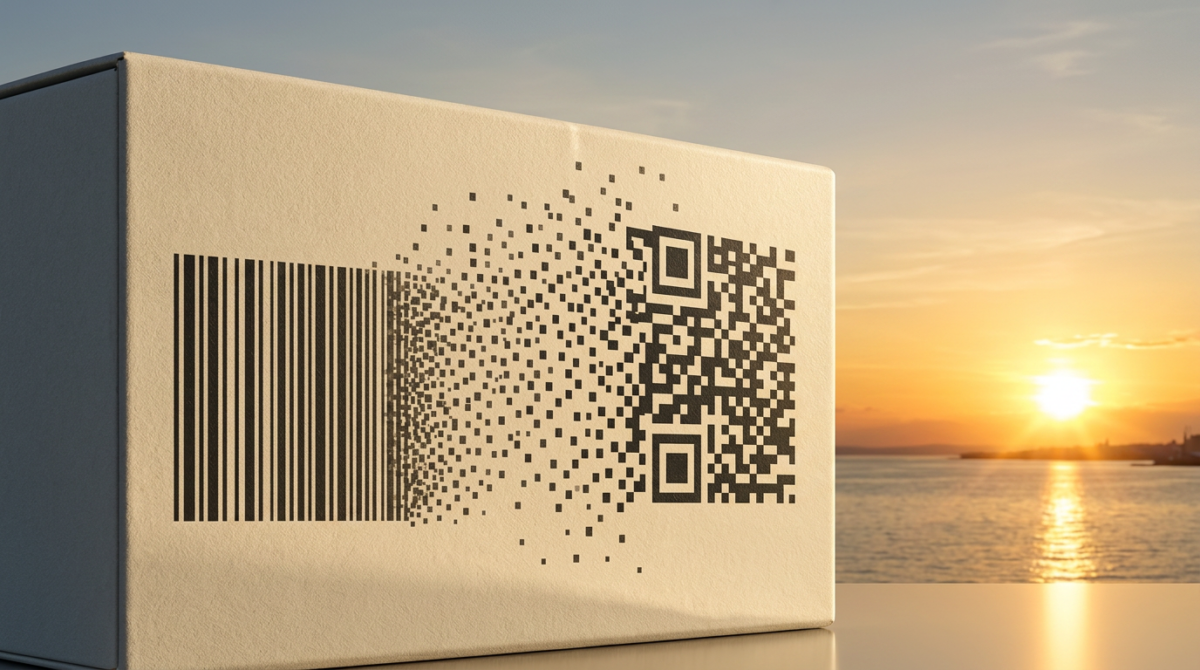
By now, you’ve probably heard the term “Sunrise 2027.” It’s the retail industry’s push, led by GS1, to move point-of-sale systems from today’s 1D barcodes to more capable 2D barcodes — the QR-style codes that can carry far more product information than a standard UPC.
Most of the conversation around Sunrise 2027 focuses on what’s inside the barcode: batch numbers, expiry dates, links to product pages. That part matters. But there’s a bigger question that gets far less attention, and it’s the one that actually determines whether a brand is ready: how is that barcode getting printed?
That’s the part we want to talk about.
A Quick Recap: What’s Actually Changing
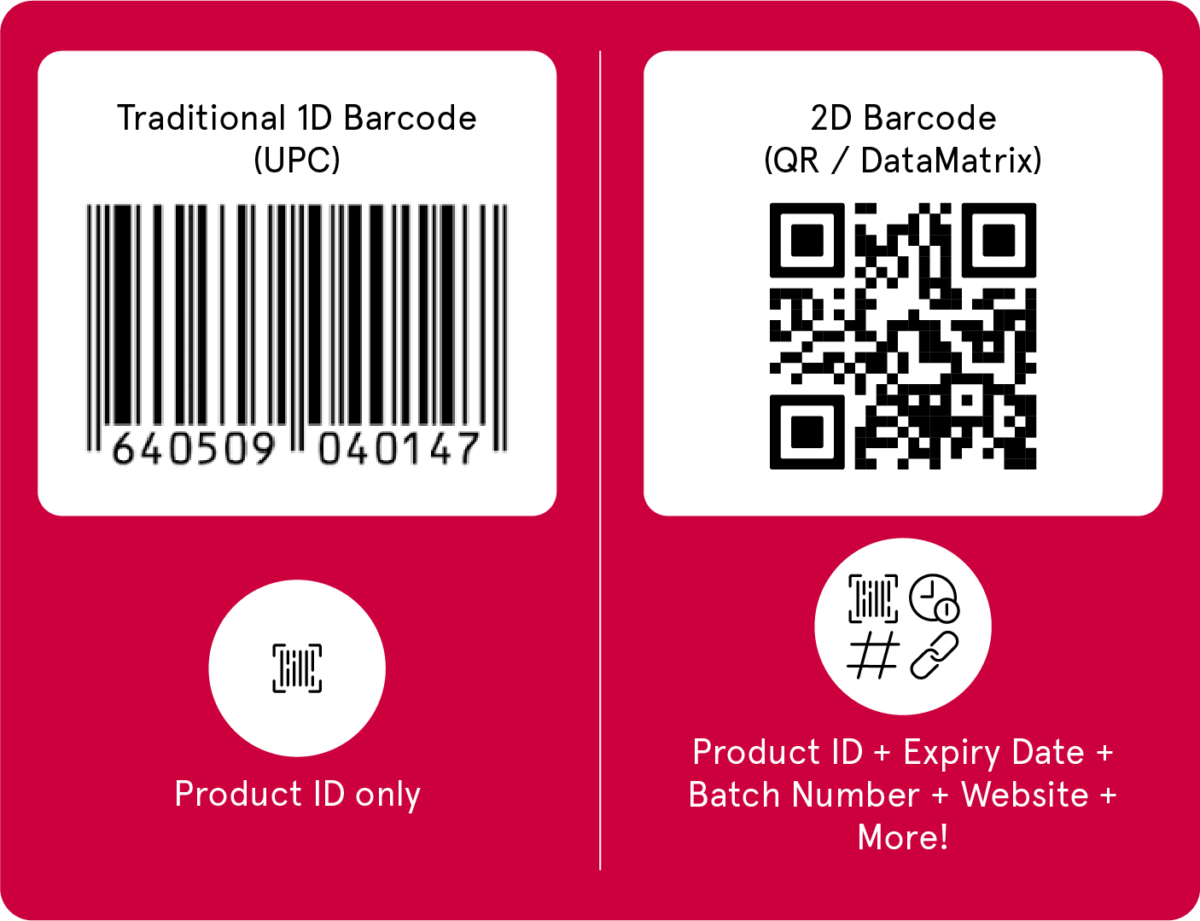
Sunrise 2027 is GS1’s target for retailers worldwide to have checkout systems capable of scanning 2D barcodes (QR codes and DataMatrix codes) by the end of 2027. It’s not a mandate, and it’s not a switch that flips overnight. Traditional 1D UPC barcodes aren’t going away; most products will carry both codes side by side for a long transition period.
A 2D barcode can hold everything a UPC does (the product’s GTIN) plus batch numbers, expiry dates, serial numbers, sustainability data, and a live link to a webpage via GS1 Digital Link. That’s a real leap in capability, and it’s why so much of the coverage treats this as a data story.
But data is only half of it.
The Part That Changes Everything: Barcodes Have to Become Variable
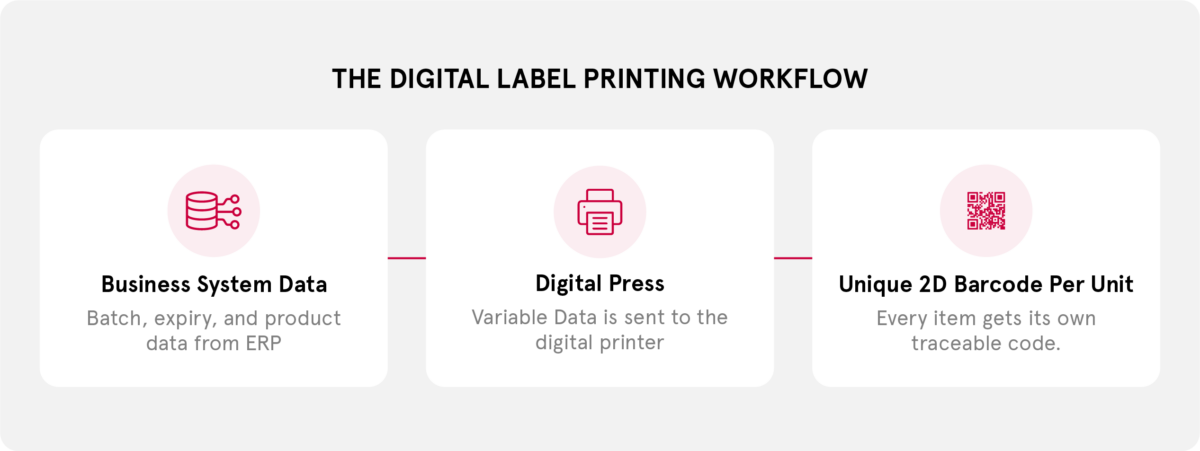
Here’s the detail that doesn’t get nearly enough attention: to get real value out of a 2D barcode (actual traceability, faster recalls, batch-level accuracy) the barcode has to carry information that’s unique to each individual unit. Not just the product. The specific unit.
That’s a fundamentally different printing problem than the one most production lines are set up to solve.
A traditional UPC is identical on every unit of a product, which is exactly why it can be bulk pre-printed — thousands of identical labels, printed once, applied many times. A Sunrise 2027-compliant 2D barcode, once it’s carrying batch or expiry data, is different on every unit. It can’t be pre-printed in bulk the same way. It has to be generated and printed at, or very close to, the moment of packaging.
That single shift is the real Sunrise 2027 challenge for most brands, and it’s a printing method problem before it’s anything else.
Why Legacy Print Methods Struggle Here
A lot of production lines today use static print methods for lot codes and dates — basic thermal or hot-stamp coders that apply a fixed message. These systems were built for simple, low-density information. They weren’t built for the fine, dense grid of a 2D barcode.
Print quality is not a minor detail with 2D codes. A 2D barcode is made up of small, tightly packed modules, and if the contrast isn’t sharp or the print isn’t clean, the code doesn’t scan poorly, it doesn’t scan at all. Retail checkout systems don’t have patience for a barcode that needs a second or third attempt.
So the real question every brand needs to ask isn’t just “do we have a 2D barcode on our label?” It’s “can our current printing setup produce one that scans reliably, every time, on every unit?” For a lot of operations, the honest answer right now is no, not without a change in how the barcode gets printed.
Where Digital and Variable Data Printing Come In
This is exactly the gap that digital printing and variable data printing (VDP) are built to close.
Variable data printing means unique information (a batch number, an expiry date, a serial number) can be generated and printed inline, as part of the production run, rather than fixed in advance. Combined with digital print technology, that unique data can be built directly into a properly formatted, GS1-compliant 2D barcode with the print quality needed to scan reliably, on every unit, without slowing down the line.
In practical terms, that means:
- No pre-printing thousands of identical codes that don’t match Sunrise 2027’s per-unit requirement
- No manual workaround of adding a second static label to patch in variable data
- Print quality built for 2D density from the start, not retrofitted onto equipment designed for something simpler
For brands weighing whether to upgrade their printing setup, this is the piece worth understanding clearly: Sunrise 2027 compliance isn’t really a barcode design question. It’s a production capability question, and digital, variable data printing is the most direct answer to it.
What This Means for Your Next Production Run
A few practical things worth knowing as you plan:
- Placement still matters. GS1 recommends placing the 2D barcode within 50mm of the existing UPC to avoid scanning errors at checkout. That’s a layout decision worth locking in early, not retrofitting later.
- You don’t need a new product number. The GTIN already encoded in your UPC carries over into the 2D barcode, it just needs to be reformatted from 12 digits to 14. No new SKU, no new registration.
- Static and dynamic aren’t interchangeable. A static 2D code (fixed content, printed like a standard label) is fine if you’re only encoding the GTIN. The moment you want batch numbers, expiry dates, or serialization (the data that actually makes Sunrise 2027 worth doing) you need dynamic, inline printing.
- This is a good moment to evaluate your equipment, not just your artwork. If you’re already planning a packaging refresh or new label order, that’s the natural point to ask whether your current print setup can actually deliver a compliant, reliably scannable 2D barcode, or whether digital and VDP capability needs to be part of the plan.
Getting Ahead of It
The good news: none of this requires solving it all at once. Start by confirming whether your current equipment can produce 2D barcodes at the print quality GS1 requires. If it can’t, that’s the conversation to have before your next production run, not after.
ID Images works with brands across North America on exactly this transition, from adding a first compliant 2D barcode to fully dynamic, serialized barcode production using digital and variable data printing. If you’re not sure where your current setup stands, we’re happy to walk through it with you.
Talk to an ID Images print specialist about your production readiness.
Frequently Asked Questions
Can my current printer produce a compliant 2D barcode?
Possibly, but the more important question is print quality and whether your setup supports variable data. Many standard digital and thermal transfer printers can produce 2D barcodes; the real test is whether they can do it at the density and contrast GS1 requires, on a per-unit basis if you need variable data.
What’s the real difference between static and dynamic barcode printing?
Static means the same code is printed on every unit — fine if you’re only encoding a fixed GTIN. Dynamic means the code changes from unit to unit, carrying batch numbers, expiry dates, or serial numbers. Sunrise 2027’s real value comes from dynamic printing.
Do I need to replace all my equipment?
Not necessarily. Some production lines can add inline digital print capability at the point of packaging without a full line overhaul. It depends on your current setup, worth a specific conversation rather than a general answer.
Is this only relevant for large-scale operations?
No. Any brand that wants the traceability and recall benefits of a 2D barcode (not just base compliance) will run into the variable printing question, regardless of size. The scale of the solution differs, but the underlying challenge doesn’t.