Tire Labels for Rubber Surfaces: Engineered Solutions Backed by North American Manufacturing
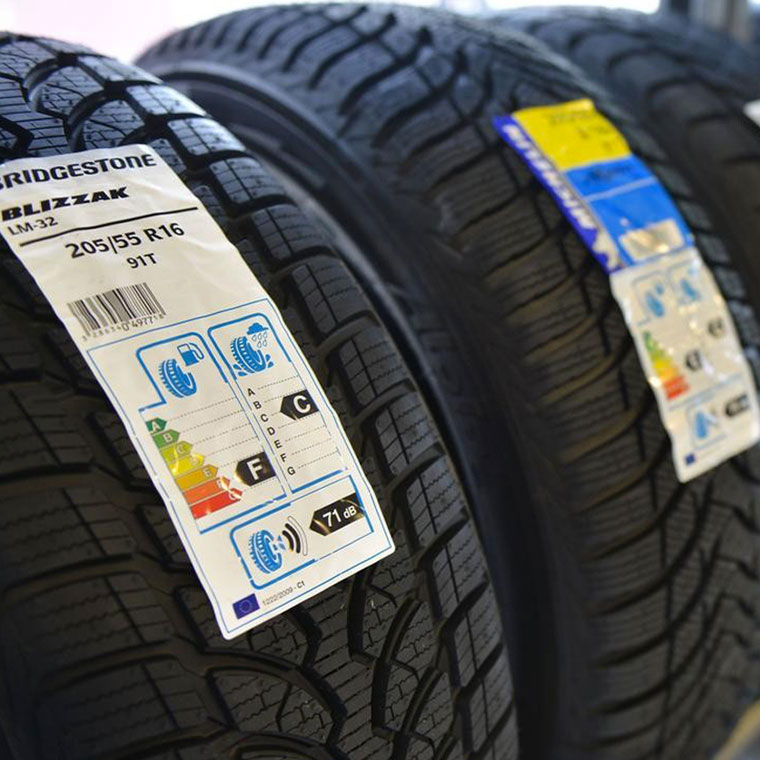
Tire labels may look simple – but labeling rubber is anything but.
From plasticizers and carbon black to curved sidewalls and environmental exposure, tires present one of the most demanding adhesions challenges in industrial labeling. Standard pressure-sensitive constructions often fail under these conditions, leading to edge lift, contamination, and adhesive transfer.
ID images with the help of our Canadian manufacturing division, Multi-Action, provides tire label solutions engineered specifically for rubber substrates.
Why Tire Labels Frequently Fail
Rubber is a low surface energy material, which makes bonding difficult. Tire surfaces often contain:
- Plasticizers and oils
- Mold release agents
- Carbon black
- Textured and curved geometries
These characteristics interfere with adhesion and commonly cause:
- Edge lifting
- Premature peeling
- Adhesive buildup
- Labels sticking during stacking
In high-volume manufacturing and distribution environments, even small failure rates can create operational disruption.
The Overlooked Issue: Adhesive at the Edge
One of the most common causes of tire label performance issues is adhesive that runs fully to the edge of the label.
When adhesive extends to the perimeter, it can:
- Transfer onto the rubber surface
- Attract debris
- Create visible edge contamination
- Compromise warehouse and retail presentation
This is not simply an adhesive strength issue — it is a construction design issue.

Engineered Tire Label Solutions
ID Images offers tire labels that include:
- High-tack adhesives formulated for low surface energy materials
- Pattern-coated adhesive constructions with adhesive inset from the edge
- Flexible synthetic facestocks such as BOPP and PET
- Durable print performance for industrial environments
By engineering the full label construction — including adhesive placement — we reduce performance risk while maintaining secure adhesion on rubber surfaces.
Built for the Entire Tire Lifecycle
Tire labels must withstand:
- Manufacturing heat
- Outdoor storage
- Moisture exposure
- Continuous stacking and transport
- Retail handling
Backed by ID Images’ North American manufacturing footprint, customers benefit from:
- Scalable production capacity
- Regional support across the U.S. and Canada
- Consistent quality control
- Technical expertise for challenging substrates
What Customers Have Experienced
“We were seeing consistent edge lift and adhesive buildup during stacking and warehouse handling. After switching to Multi-Action’s pattern-coated construction, we eliminated adhesive transfer and significantly improved label performance on our rubber surfaces.”
– Procurement Manager, North American Tire Manufacturer
“From a production standpoint, tire labels demand precision. Adhesive placement tolerance, coating consistency, and material selection all have to work together. We’re not just running a job — we’re building a construction designed for rubber chemistry, curvature, and real-world handling. When the adhesive is inset correctly and paired with the right synthetic facestock, you get durability without the mess.”
– Production Manager, Multi-Action/ID Images
The Bottom Line
Tire labeling requires more than a standard pressure-sensitive solution.
It requires engineered adhesive placement, specialized high-tack formulations, and durable synthetic materials designed for real-world conditions.
With Multi-Action’s rubber application expertise and ID Images’ North American manufacturing capabilities, we deliver tire labels built to perform under pressure.