Passive vs. Active RFID: What’s Right for Your Application?
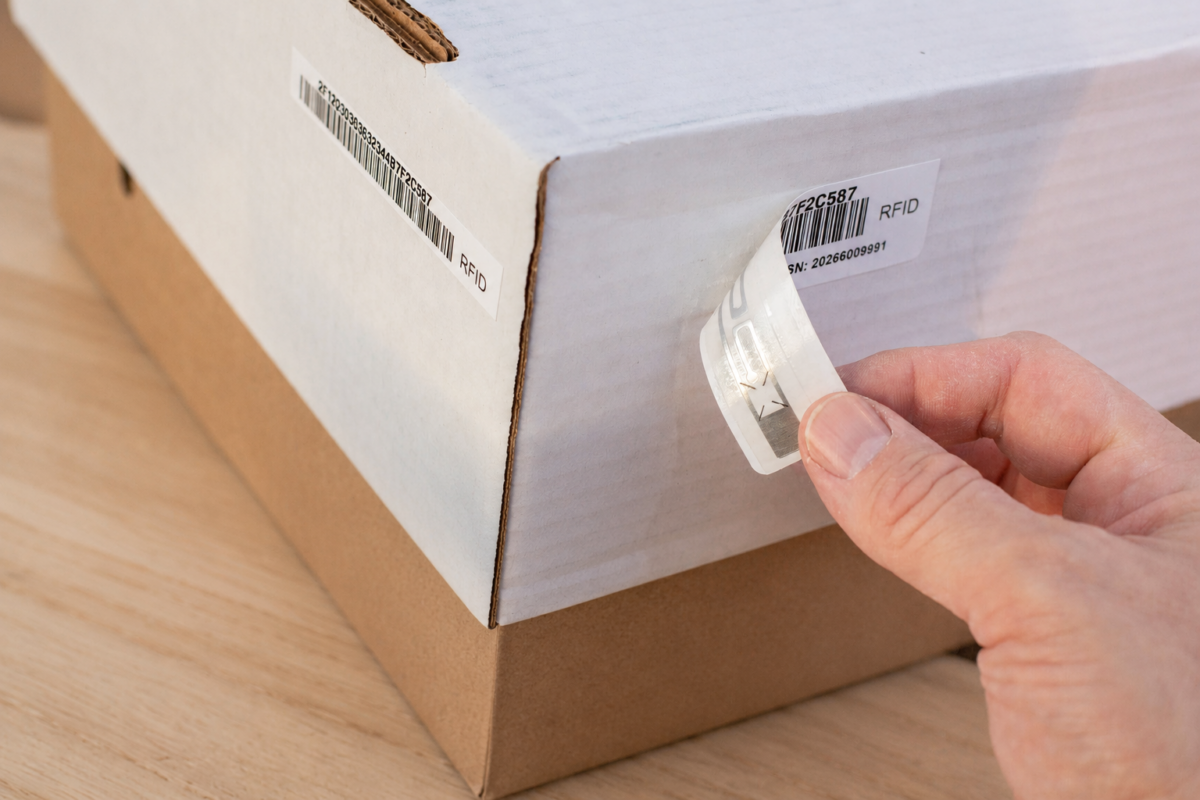
RFID can make inventory faster, improve asset visibility and reduce the amount of manual work required to track products throughout the supply chain.
But deciding to use RFID is only the beginning.
One of the first questions is what type of RFID technology makes sense for the application?
Two of the most common categories are passive and active RFID. Both use radio frequency technology to identify and track objects, but the way they operate and the applications they are best suited for can be very different.
Choosing between them comes down to what you are tracking, how far away you need to read it, how frequently you need information and what the economics of the application look like.
Here’s how the two technologies compare.
What Is Passive RFID?
A passive RFID tag does not contain its own power source. Instead, it receives energy from the radio signal transmitted by an RFID reader. The tag uses that energy to respond with the information stored on its chip.
That simple distinction has a major impact on what passive RFID can do.
Without a battery, passive tags can be small, thin and incorporated directly into pressure-sensitive labels, making them practical for high-volume applications where individual items, cases or pallets need their own unique RFID identity.
Passive UHF RFID, commonly referred to as RAIN RFID, is widely used for inventory and supply-chain applications. GS1’s EPC Gen2 standard provides the foundation for interoperable passive UHF RFID systems used across industries.
Common passive RFID applications include:
- Retail inventory management
- Warehouse and distribution center tracking
- Case and pallet identification
- Apparel and footwear
- Manufacturing and work-in-process tracking
- Healthcare supplies
- Logistics and supply-chain visibility
- Returnable assets and containers
For applications involving thousands—or millions—of tagged items, the economics and form factor of passive RFID can make it particularly attractive.
What Is Active RFID?
Active RFID works differently.
Instead of relying entirely on energy from a reader, an active RFID tag contains its own power source, typically a battery, and has its own transmitter. This allows the tag to transmit information over greater distances and, depending on the system, communicate at predetermined intervals rather than waiting for a nearby reader to energize it.
That additional capability also changes the tag itself.
Active RFID tags are generally larger, more complex and more expensive than passive RFID labels. Their batteries also give them a finite service life.
In return, they can provide capabilities that make sense for applications where knowing the location or condition of a high-value asset is more important than minimizing the cost of each tag.
Active RFID may be used for:
- Tracking high-value equipment
- Locating assets throughout large facilities
- Vehicle and fleet tracking
- Yard management
- Tracking reusable transportation assets
- Monitoring equipment movement
- Applications requiring frequent location updates
Some active systems can also incorporate sensors that monitor conditions such as temperature, movement or other environmental factors.
Passive vs. Active RFID: What’s the Difference?
At a high level, the difference comes down to power, range, cost and the type of visibility required.
| Passive RFID | Active RFID | |
| Power source | Powered by RFID reader signal | Internal battery |
| Tag type | Often thin label or inlay | Typically larger device |
| Read distance | Shorter | Longer |
| Tag cost | Lower | Higher |
| Battery Life | No Internal Battery | Internal Battery |
| High-volume tagging | Well suited | Typically less practical |
| Continuous location tracking | Limited | Better suited |
| Typical use | Products, cases, pallets and inventory | High-value assets and equipment |
Neither approach is inherently better.
The right choice depends on what the RFID system needs to accomplish.
Start With What You’re Trying to Track
One of the easiest ways to narrow the decision is to look at the value and volume of the items being tagged.
Imagine a distribution center that needs RFID visibility for 100,000 cases moving through its operation.
Placing a battery-powered active device on every case would likely add unnecessary complexity and cost. A passive RFID label can provide each case with a unique identity while supporting rapid, automated data capture as products move through defined read points.
Now consider a company trying to locate several hundred pieces of expensive equipment spread throughout a large facility.
The economics are completely different.
If knowing exactly where that equipment is located can prevent hours of searching or avoid replacing an asset that cannot be found, a more sophisticated active tracking system may be justified.
The question becomes: How much visibility does the application actually require?
Do You Need to Know Where Something Is or When It Passes a Point?
This distinction is particularly important.
Passive RFID is extremely effective when businesses want to know that an item passed through a specific location.
For example:
A pallet moves through a dock door.
A case enters a conveyor portal.
An employee performs a cycle count.
Inventory passes through a receiving area.
In each situation, readers capture the RFID tags when they enter the read zone. Multiple passive RFID-tagged items can be identified without requiring direct line of sight, helping automate processes that might otherwise depend on individual barcode scans.
Active systems can be more appropriate when the requirement is closer to:
“Where is this asset right now?”
Instead of relying exclusively on predetermined read points, an active tracking infrastructure can provide broader location awareness across a facility, yard or other environment.
That difference can completely change the system design.
Consider the Cost of the Entire RFID System
Tag price matters—but it isn’t the only cost to consider.
An RFID deployment may include:
- RFID tags or labels
- Readers
- Antennas
- Printers and encoders
- Software
- System integration
- Installation
- Testing
- Ongoing maintenance
The best RFID solution is not necessarily the one with the greatest technical capability.
It is the one that provides the right amount of visibility at a cost that makes sense for the operation.
For high-volume item-level, case-level or pallet-level tagging, passive RFID frequently provides that balance.
The Label Matters, Too
With passive RFID, choosing the technology is only part of the process.
An RFID label still has to function as a label.
That means considering the surface it will be applied to, the environment it will encounter and how it will move through production and distribution.
Factors such as these can affect RFID performance:
- Metal surfaces
- Liquids
- Container composition
- Tag placement and orientation
- Label size
- Adhesive requirements
- Temperature
- Moisture
- Chemicals
- Required read distance
- Reader and antenna configuration
An RFID inlay that performs well on one product may behave very differently when applied to another.
That is why RFID projects should be evaluated as complete applications rather than simply choosing a chip or inlay from a specification sheet.
So, Which RFID Technology Is Right for You?
A few questions can help point you in the right direction.
- How many items need to be tagged?
High-volume applications often favor passive RFID because of its lower tag cost and label-friendly format. - How far away do you need to read the tag?
If extremely long-range communication is essential, active RFID may make more sense - Do you need continuous location information?
Active technology may be better suited for applications where assets need to be located throughout a large space rather than simply captured at defined checkpoints. - How valuable is the item being tracked?
A more expensive tag can be easier to justify on a high-value reusable asset than on an individual consumer product or shipping case. - What is the application environment?
Materials, surfaces, temperature, moisture and surrounding equipment can all affect RFID performance.
And perhaps most importantly: What problem are you trying to solve?
Starting with that question usually leads to a better RFID system than starting with the technology itself.
Finding the Right RFID Solution
RFID is not one-size-fits-all.
In many inventory, warehouse, retail and supply-chain applications, passive RFID provides an effective way to add item-level intelligence without adding a battery or bulky tracking device to every asset.
Other applications require the additional range and location capabilities of an active system.
The important part is matching the RFID technology, tag construction and system design to the way the product or asset actually moves through the real world.
ID Images can help evaluate your RFID application, identify the right RFID label and inlay configuration, and develop a solution designed around your products, environment and operational requirements.